Agentic AI is having a moment. Every vendor demo features an "autonomous" assistant that can read, decide, and act across workflows — and in healthcare operations, that promise is genuinely attractive. Administrative burden is real, expensive, and growing.
But healthcare is also a domain where the wrong automation can create compliance exposure, operational instability, and even patient harm. The practical question is not whether agentic AI is "the future." The real question is: where is it real today, and where is it irresponsible?
This article lays out a decision-grade framework healthcare organizations can use to separate safe, high-ROI automation from risky overreach — and how to implement agentic capabilities with governance-first controls.
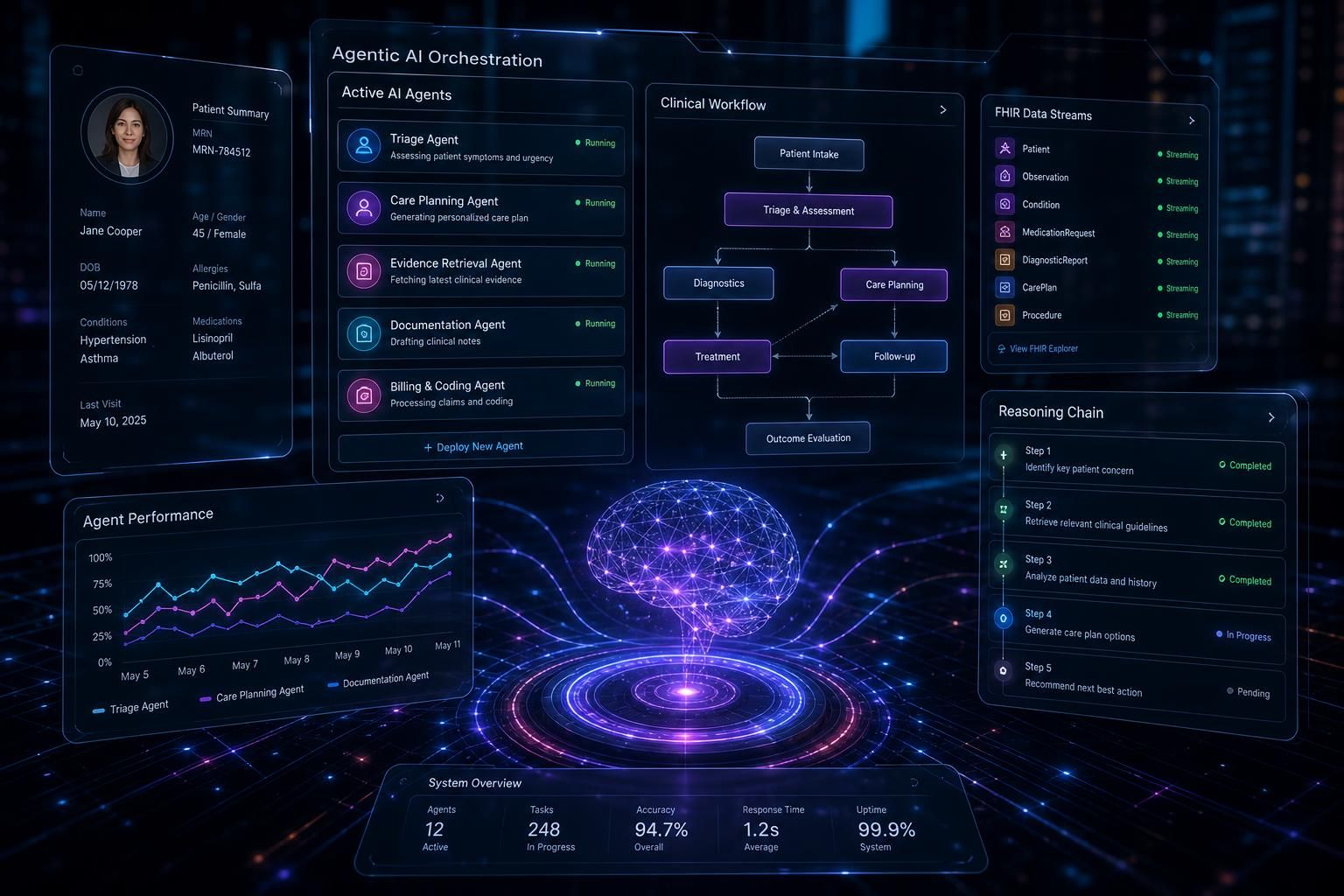
Define the terms: automation, copilots, and agents
Most "agentic" conversations collapse three distinct patterns into one buzzword. Pulling them apart is the first step toward responsible adoption.
- ▸Automation (deterministic). Rules, workflows, and scripts that execute predefined steps. High reliability, low ambiguity.
- ▸Copilots (assistive). AI that drafts, summarizes, classifies, or recommends — with a human approving the final action.
- ▸Agents (delegated autonomy). AI that plans and executes multi-step tasks across systems with limited human involvement.
In healthcare ops, the safest near-term value is typically automation + copilots, with true agents introduced only in tightly bounded contexts.
Where agentic AI is real today
The strongest "real today" use cases share three traits: low clinical risk, bounded scope, and auditable actions. When all three are present, the risk-adjusted ROI is compelling.
1. Intake triage and routing
An agent can classify inbound requests — eligibility questions, prior auth status, claims corrections, provider directory updates — and route them to the correct queue with the right metadata. The action is reversible, the risk is manageable, and the productivity gain is immediate.
Controls required: PHI-aware redaction, role-based access control (RBAC), routing rules, and end-to-end audit logs.
2. Document understanding for ops workflows
Extracting structured fields from operational documents (EOBs, remits, 277/999 acknowledgements, benefit letters, provider rosters) and generating exception summaries. The agent is accelerating review and exception handling — not diagnosing or prescribing.
Controls required: Confidence thresholds, human review for low-confidence extractions, and provenance — what source text produced what field.
3. Drafting communications with human approval
Drafting member and provider outreach, appeals support letters, claim status updates, and internal handoffs. Humans remain the final approver while the agent compresses time-to-response.
Controls required: Template constraints, approved language libraries, and full logging of prompts and outputs.
4. "Next step" recommendations in care management ops
Suggesting next-best-actions — schedule follow-up, request missing documentation, route to nurse review — based on policy and historical outcomes. Recommendations can be bounded to allowed actions and require approval before execution.
Controls required: Policy grounding, explicit reason codes, and human-in-the-loop approval.
5. Data pipeline operations and reliability
Detecting anomalies, summarizing pipeline incidents, proposing remediation steps, and generating post-incident reports. This is operational engineering — high leverage, low patient-facing risk.
Controls required: Change control, approval gates, and strict separation between "recommend" and "execute."
Where agentic AI is irresponsible (or premature)
In healthcare, "irresponsible" usually means one of three things: the agent can take irreversible actions, the agent operates on ambiguous or incomplete data, or the organization cannot audit and defend the decision after the fact.
Autonomous clinical decision-making
If an agent is deciding diagnoses, medication changes, or clinical pathways without clinician oversight, the risk profile is unacceptable for most real-world settings.
Unbounded access across systems — the "god-mode agent"
Agents that can freely navigate EHRs, claims systems, and communication tools without least-privilege controls create a security and compliance nightmare. One prompt injection or misclassification, and the blast radius is the entire enterprise.
Automated denial or benefit determinations
Using agents to make or execute coverage decisions without rigorous governance, transparency, and appeal-safe workflows is high risk — ethically, operationally, and increasingly, from a regulatory standpoint.
Write-back to source-of-truth systems without validation
If an agent can update eligibility, member demographics, provider directory entries, or clinical records without a validation layer, you are inviting data corruption at scale.
"Black box" agents with no traceability
If you cannot answer "why did the agent do that?" with an auditable trail, you cannot defend it — internally or externally.

The implementation reality: agents are only as good as your data and controls
Healthcare organizations consistently underestimate the prerequisites. The demo works because the demo data is clean. Production is different.
- ▸Identity resolution and attribution. If you cannot reliably match members and patients across sources, the agent will confidently act on the wrong person.
- ▸Data contracts and validation gates. If upstream feeds drift, the agent will quietly degrade — and you will not notice until a stakeholder does.
- ▸Workflow instrumentation. If you cannot capture outcomes (what happened after outreach), you cannot improve.
- ▸Governance and security-by-design. Without RBAC, logging, and PHI controls, you cannot scale safely past pilot.
This is why most "agentic AI pilots" stall at month four to six: the demo works, but production requires reliability engineering.
A practical guardrails framework
Before deploying any agent in healthcare ops, require these guardrails as a non-negotiable checklist:
- ▸Least privilege. The agent only has access to the minimum systems and actions required.
- ▸Human approval gates. Required for any action that is irreversible, patient-impacting, or financially material.
- ▸Audit logs. Inputs, outputs, actions taken, timestamps, and the policy or rule context — all queryable.
- ▸Confidence thresholds. Low-confidence outputs trigger review, not execution.
- ▸PHI handling. Redaction, secure storage, encryption, and clear retention policies.
- ▸Rollback and incident response. Documented procedures when an agent misroutes, misclassifies, or corrupts data.
- ▸Monitoring. Drift, error rates, latency, and outcome metrics tracked continuously.
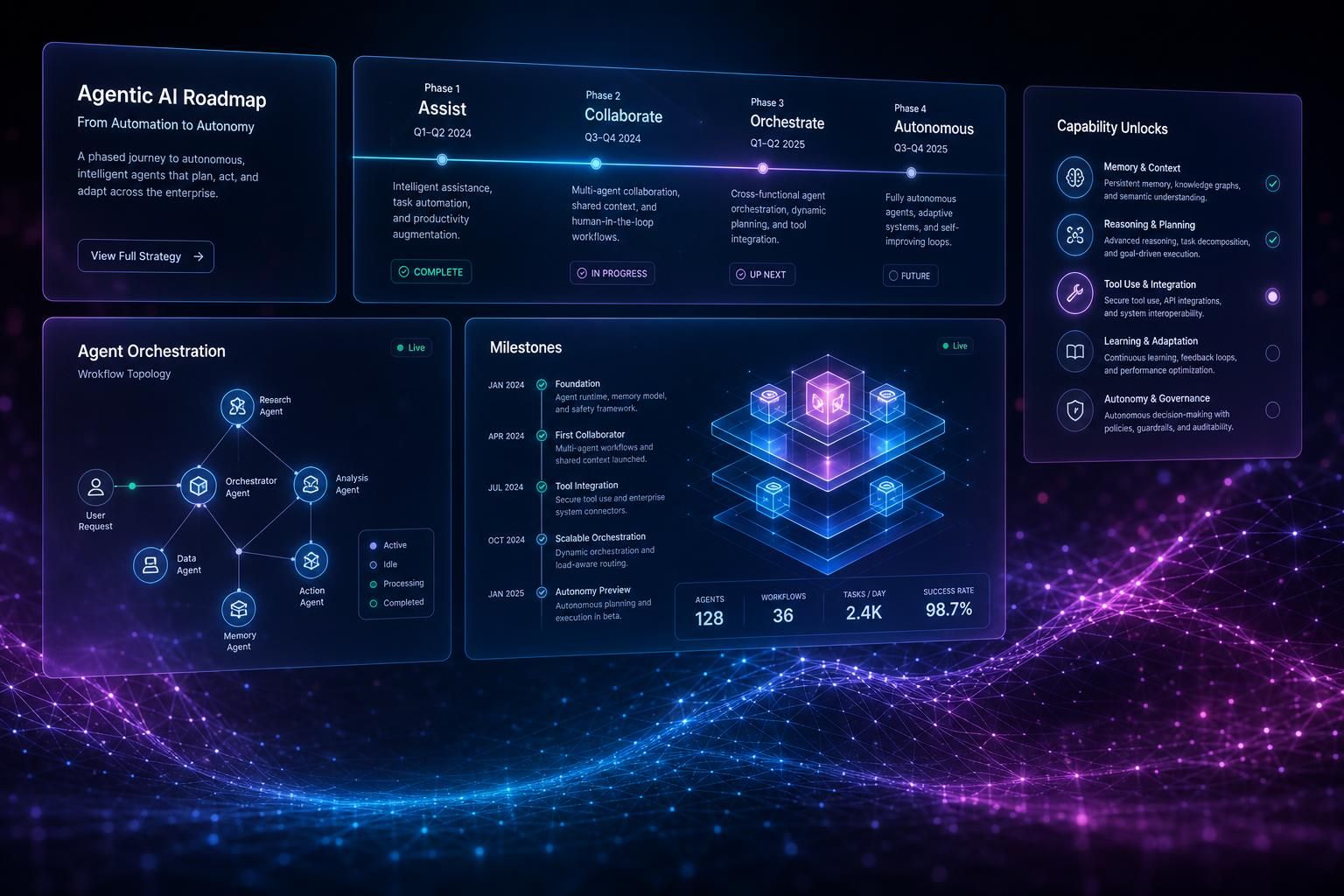
A phased roadmap: how to adopt agentic AI responsibly
Responsible rollout is incremental. Skipping phases is how organizations end up with high-profile failures and stalled programs.
Phase 1 — Copilot-first (2–6 weeks)
Summarization, drafting, classification, and routing — all with human approval. Build the muscle of measuring AI-assisted work before you delegate execution.
Phase 2 — Bounded agents (6–12 weeks)
Multi-step tasks in narrow domains (e.g., claims exception triage) with strict permissions, validation gates, and reversibility built in.
Phase 3 — Semi-autonomous execution (12+ weeks)
Limited write-back actions, only after reliability targets are met and governance is proven against real-world variance.
Where Brandywine Consulting Partners fits
Agentic AI in healthcare operations is not primarily a model problem. It is an interoperability, governance, and operational reliability problem — and that is exactly where BCP operates every day.
We help healthcare organizations implement agentic capabilities that are production-grade:
- ▸Interoperability enablement across FHIR, HL7, and X12, with secure data integration patterns
- ▸Azure-native data platforms and analytics engineering tuned for healthcare workloads
- ▸Governance-first controls including RBAC, auditability, PHI handling, and validation gates
- ▸Workflow integration so AI outputs become measurable operational outcomes, not stranded insights
- ▸Managed services for monitoring, incident response, and continuous improvement after go-live
The mandate: start with discipline, not a demo
The organizations that win with agentic AI in the next 24 months will not be the ones that deployed the most autonomy fastest. They will be the ones that deployed the right autonomy, in the right places, with the right controls — and could prove it.
If you are exploring agentic AI in healthcare operations, start with a disciplined assessment. Brandywine Consulting Partners can lead an Agentic AI Readiness & Guardrails Workshop to identify the highest-ROI "real today" use cases for your organization, the controls required to deploy them safely, and a phased roadmap from copilots to bounded agents you can actually defend.
Ready to put this into practice?
BCP partners with healthcare and life sciences leaders to translate strategy into shipped, secure systems. Let's talk about your next initiative.
Talk to BCP