
How manual rework consumes the value of an API investment
Your prior authorization API can be live while your employees are still doing the integration.
They rekey information the interface accepted. They chase attachments that never reached the reviewer. They reconcile a portal status with an EHR work queue. Every repair consumes the return your interoperability program was supposed to deliver.
We call that recurring burden the prior authorization exception tax: the avoidable work created when systems exchange transactions without reliably completing the business process. It is an operating cost, not a government levy. It belongs in the same executive conversation as implementation spending, patient access, and financial performance.
Our earlier CMS-0057-F article challenged the gap between compliance and operational readiness. This follow-up asks the budget question: how much human labor is concealing the remaining integration failures? A launch report cannot answer it. A reconciled case history can. [1]
The deadline does not establish the return
CMS-0057-F applies to specified Medicare Advantage, Medicaid, CHIP, and federally facilitated Exchange QHP payers. Operational provisions generally began in 2026; API requirements generally begin in 2027, with dates varying by payer type. Non-drug prior authorization is the relevant scope here. These are not blanket requirements for every commercial plan or every provider. [2]
The 2025 AMA survey, released in May 2026 and based on 1,000 practicing physicians, reported an average of 13 hours of physician and staff time per week spent on prior authorization. Those self-reported findings cover broader prior authorization activity; they do not measure CMS-0057-F implementation outcomes or predict a particular organization's savings. They do show why a technology investment must be judged against the work it removes. [4]
For a payer executive, unresolved exceptions can mean avoidable handling cost and unreliable operational evidence. For a provider executive, they can mean staff effort, disrupted scheduling, and delayed billing. For both, the business case becomes difficult to defend when the project closes but the repair work continues.
The work your API dashboard cannot see
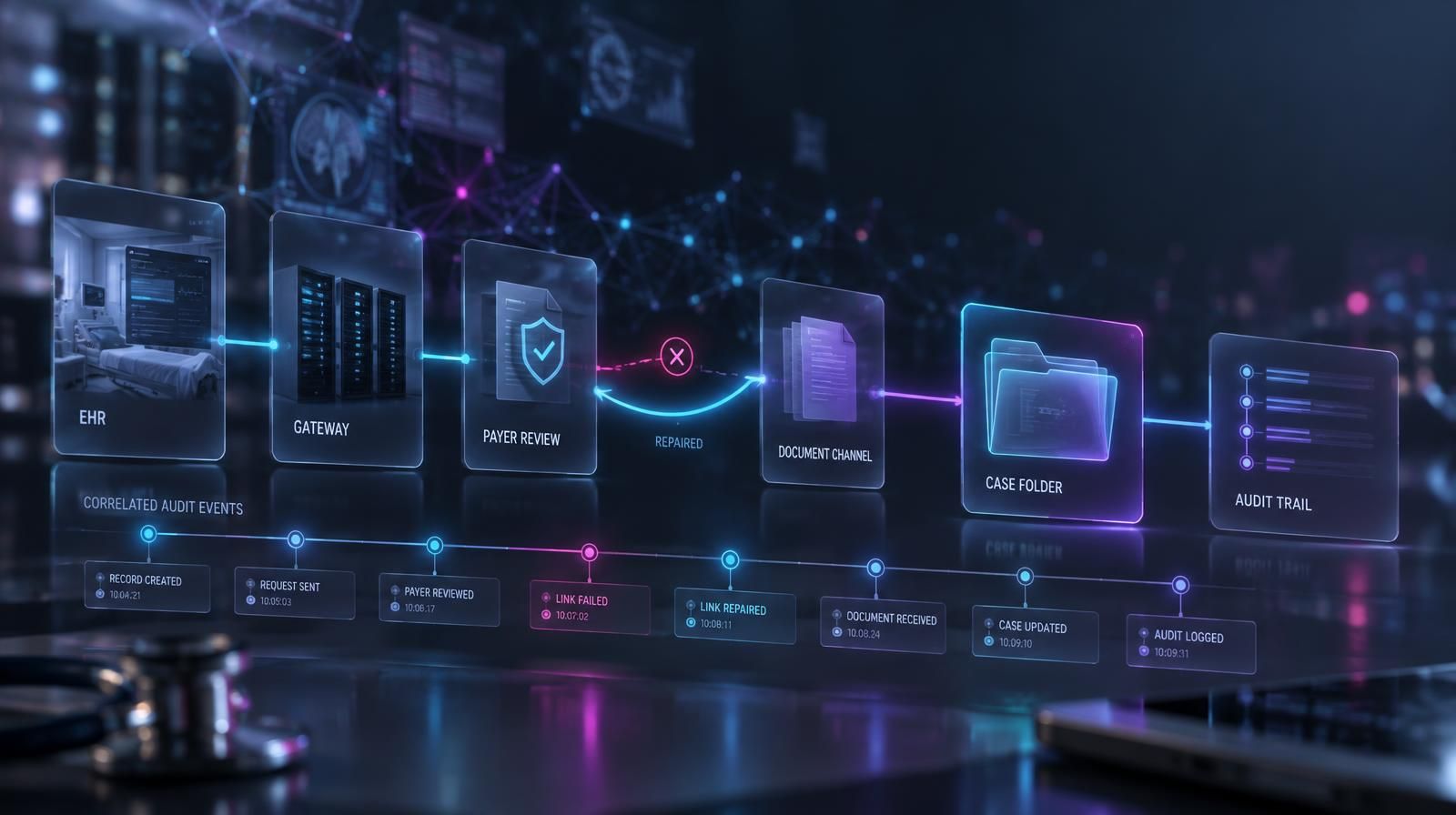
Consider an illustrative imaging authorization. An EHR submits the request, the gateway accepts it, and the transaction appears successful. The payer then requests additional documentation. That request fails to reach the responsible clinical work queue. Staff discover it through a phone call, upload the document through a portal, and manually update the EHR.
The initial API exchange succeeded. The workflow required a human rescue. If the portal case receives a second identifier, the organization may also create duplicate work and lose the link between the original submission and final determination. This is an engineering failure scenario, not a claim about a particular payer or BCP client.
A dashboard built only from gateway logs may never show the rescue. An eventual approval rate can look acceptable while the cost of obtaining each decision rises. That is why leadership should demand evidence of avoidable manual touches, unresolved handoffs, and completed case reconciliation alongside availability and response time.
Clinical review is not an integration defect. CMS explicitly says the rule does not require real-time prior authorization decisions. The target for automation should be avoidable administration, with appropriate clinical judgment preserved. [3]
Fallback channels still carry obligations
CMS guidance says applicable decision deadlines run in calendar time and apply across API, portal, fax, phone, and other channels. For impacted payers other than FFE QHP issuers, decisions must be as expeditious as the patient's condition requires, within the applicable 72-hour expedited or seven-calendar-day standard limit, subject to program-specific extension conditions. [3]
BCP recommends preserving the original receipt event, channel changes, extension authority, and linked case identifiers in one accountable history. A retry or a move to a portal should not silently overwrite the evidence used to calculate the applicable deadline. Technology teams need compliance-approved rules for the relevant line of business, rather than a generic timer.
This creates a direct procurement question: who owns an accepted request that never reaches the next responsible team? If the gateway vendor, EHR vendor, and utilization management vendor each report success, someone still has to own the incomplete workflow. Name that owner and require a measurable recovery path.
Ask BCP to scope a Prior Authorization Exception Review. Start with one high-volume workflow and trace the handoffs that generate the most rework.
Request a Prior Authorization Exception Review
Put a price on avoidable rework
A useful starting estimate multiplies monthly unique authorization cases by the share requiring avoidable manual repair, the average total repair time per affected case, and the fully loaded hourly labor cost. Count all repair touches for a case once in its total handling time. Keep necessary clinical review separate.
Monthly repair cost = unique monthly cases × avoidable repair share × repair minutes per affected case ÷ 60 × fully loaded hourly labor cost.
The following example uses hypothetical inputs. It is a planning calculation, not an industry benchmark, measured BCP result, or savings commitment.
| Illustrative input | Assumption |
|---|---|
| Unique authorization cases per month | 20,000 |
| Cases requiring avoidable manual repair | 30% |
| Total repair time per affected case | 18 minutes |
| Fully loaded labor cost | $55 per hour |
| Calculated monthly repair effort and cost | 1,800 hours and $99,000 |
| Annualized gross labor capacity cost | $1,188,000 |
The arithmetic is 20,000 × 30% × 18 ÷ 60 × $55 = $99,000 per month. Holding volume, handling time, and labor cost constant, reducing the exception share from 30% to 20% would release 600 hours of monthly capacity, valued at $33,000 per month or $396,000 per year.
Capacity value is not automatically cash savings. Finance must determine whether improvement avoids hiring, reduces overtime, permits redeployment, or reduces expenditure. The net business case must deduct implementation and operating costs. Do not add potential revenue recovery to labor value without checking for overlapping benefits and validating the causal link.
Measure completed work across the whole population
For internal management, BCP recommends an all-channel denominator of distinct in-scope cases, with documented rules for amendments, retries, withdrawals, appeals, and partial decisions. Reconcile the case population against authoritative operational systems. Keep this management view separate from the precise definitions used for required regulatory reporting.
For each payer, service line, and workflow, compare the manual repair share, repair minutes, age of unresolved exceptions, and the percentage of decisions successfully returned to the originating work queue. Count acknowledgements and final determinations as different events. An approval that nobody can act on is still unfinished operational work.
Validate improvements against comparable case mixes and reporting windows. Otherwise, shifting difficult cases to a portal can make the API pathway appear more efficient without reducing total work. A performance measure becomes useful only when the team cannot improve it simply by moving failures outside its denominator.

Make the reporting evidence reproducible
CMS already requires public aggregated prior authorization metrics, including approval and denial percentages and average and median decision times. Those disclosures are important, but an aggregate cannot identify every local failure in a particular service line or partner connection. [3]
BCP recommends retaining the governed transformation rules that connect operational events to each published figure. An analyst should be able to trace a reported total back to the included cases, explain exclusions, and reproduce the result using the applicable definition version. Changes to the pipeline need reconciliation evidence and an accountable approver.
The proposed CMS-0062-P adds a timely reason to address this now. CMS proposes additional non-drug counts and outcomes, as well as usage reporting for Provider Access, Payer-to-Payer, and Prior Authorization APIs. Proposed API usage measures include unique prior authorization requests and the share received through the API. The proposal would begin that usage reporting in 2028 using 2027 data. [5] · [6]
As of the sources reviewed on October 26, 2026, these changes remain proposed. They are not current CMS-0057-F obligations. CMS also proposes extending prior authorization requirements to drugs, with different approaches for medical and pharmacy benefits. Implementation teams should monitor the final disposition and design adaptable reporting without treating proposed dates or scope as settled law. [5]
Our inference is straightforward: leadership should expect more questions about actual adoption and use. An operational event model built only for an endpoint uptime report will be expensive to retrofit when the organization needs evidence about cases and outcomes.
Require evidence before accepting the workflow
BCP recommends testing a small set of consequential failure paths with the actual trading partner before expanding volume:
- ▸A duplicate submission or timeout preserves the original case and does not create a second clinical review.
- ▸An additional-information request reaches the correct team, and its response attaches to the correct case.
- ▸A delayed or out-of-order response cannot overwrite a newer determination or leave conflicting statuses unresolved.
- ▸A portal or fax fallback remains linked to the case, its timing evidence, and an assigned reconciliation owner.
- ▸A request made with the wrong organization or patient authorization context is rejected and recorded appropriately.
The acceptance evidence should show what failed, what recovered, and who owns any remaining exception. These are BCP engineering recommendations; they are not an additional CMS checklist. Establish the required standards and partner-supported versions for each interface before writing the acceptance criteria.
Where BCP turns the findings into working systems
Brandywine Consulting Partners brings healthcare integration, data engineering, analytics, and AI governance capabilities to the same operational problem. Our published services cover HL7 and FHIR transformation, secure transaction routing, automated data pipelines, reporting, and governance controls. That combination allows an engagement to connect the workflow defect to its technical cause and the measure used to prove improvement. Transaction Layer Integration · Analytics & Reporting · AI Governance & Compliance
A focused engagement can begin with one service line or trading partner. We propose mapping the current case lifecycle, reconciling the request population, and measuring repair work before recommending a remediation scope. The review should produce an evidence-based backlog: each material issue tied to affected volume, operational consequence, accountable owner, and a testable acceptance criterion.
The implementation work can then target the actual failure: an identity mapping defect, an unreliable additional-information handoff, a missing case correlation, or a reporting transformation that loses channel history. A dashboard cannot repair these defects on its own. The integration and data model must support the behavior the dashboard claims to measure.
BCP's analytics services can support management views of exception volume, aging, handling effort, and partner performance. Our governance work can define access boundaries, change approvals, retention rules, and evidence requirements. Sensitive clinical content should remain in approved systems; operational telemetry should contain only the information needed for its authorized purpose. [8] · [9]
Use AI only where its contribution can be verified
An AI assistant may help classify an administrative exception, retrieve an approved policy, or draft a documentation checklist. BCP recommends preserving the source evidence, recording the model and policy versions, and measuring whether the assistance reduces rework without introducing unsupported content. Restrict tool permissions and require appropriate review before consequential submissions or decisions.
A fluent summary cannot substitute for a missing source document or a valid authorization. Automating an unreliable handoff can reproduce the same defect at higher volume. First make the case history dependable; then evaluate AI against that controlled workflow.
Request a Prior Authorization Exception Review
Before accepting a launch report or approving another automation investment, ask your team to explain the work still being repaired by hand. If they cannot quantify it, the business case is incomplete.
Ask Brandywine Consulting Partners to scope a review of your highest-friction prior authorization workflow. Bring your architecture, vendor dependencies, approximate monthly volume, and the handoff that creates the most rework. We can help define the assessment, prioritize implementation work, and establish evidence for measuring the result. Scope, timing, and deliverables are agreed for your environment.
Request a Prior Authorization Exception Review
Use the subject “Prior Authorization Exception Review” and identify whether you are a payer, provider, or technology vendor. Include a high-level problem description; send patient-level records only through an approved secure channel.
contact@brandywine.consulting · 1-872-272-6399
Continue the CMS-0057-F series
- ▸The Gap Between CMS-0057-F Compliance and CMS-0057-F Readiness: why regulatory compliance and operational readiness are different questions.
- ▸January 1, 2027 Is Not a FHIR Deadline. It Is a Workflow Deadline.: design the complete authorization lifecycle, not just an endpoint.
- ▸No Data at Rest: Designing a Healthcare Transaction Layer That Leaves No PHI Behind: connect workflow recovery with privacy-conscious transaction architecture.
- ▸AI Without Governance Is Just Risk at Machine Speed: make model evidence, access boundaries, and accountability part of the design.
References
Sources reviewed October 26, 2026. Numbered citations support the associated factual claims. The cost scenario and operational recommendations are BCP analysis. Regulatory applicability depends on payer type, program, and the governing requirements.
- ▸[1] Brandywine Consulting Partners. The Gap Between CMS-0057-F Compliance and CMS-0057-F Readiness. September 1, 2026. Prior article and series context.
- ▸[2] Centers for Medicare & Medicaid Services. CMS Interoperability and Prior Authorization Final Rule CMS-0057-F. January 17, 2024. Scope, dates, and API requirements.
- ▸[3] Centers for Medicare & Medicaid Services. Improving Prior Authorization Processes. Implementation FAQs. Decision timeframes, channels, reporting, and real-time decisions.
- ▸[4] American Medical Association. AMA survey finds prior authorization reform pledge falls short with physicians. May 13, 2026. Findings from the 2025 physician survey.
- ▸[5] Centers for Medicare & Medicaid Services. 2026 CMS Interoperability Standards and Prior Authorization for Drugs Proposed Rule. April 10, 2026. Proposed changes under CMS-0062-P, including API usage reporting dates.
- ▸[6] Centers for Medicare & Medicaid Services. Proposed Metrics in the 2026 CMS Interoperability Standards and Prior Authorization for Drugs Proposed Rule. April 2026. Proposed outcome and API usage measures.
- ▸[7] Brandywine Consulting Partners. Transaction Layer Integration. Transformation, routing, and integration controls.
- ▸[8] Brandywine Consulting Partners. Analytics & Reporting. Dashboards, data pipelines, and operational reporting.
- ▸[9] Brandywine Consulting Partners. AI Governance & Compliance. Data governance, auditability, and operating controls.
Read online: www.brandywine.consulting/insights/cms-0057f-exception-tax
© 2026 Brandywine Consulting Partners · www.brandywine.consulting
Ready to put this into practice?
BCP partners with healthcare and life sciences leaders to translate strategy into shipped, secure systems. Let's talk about your next initiative.
Talk to BCP