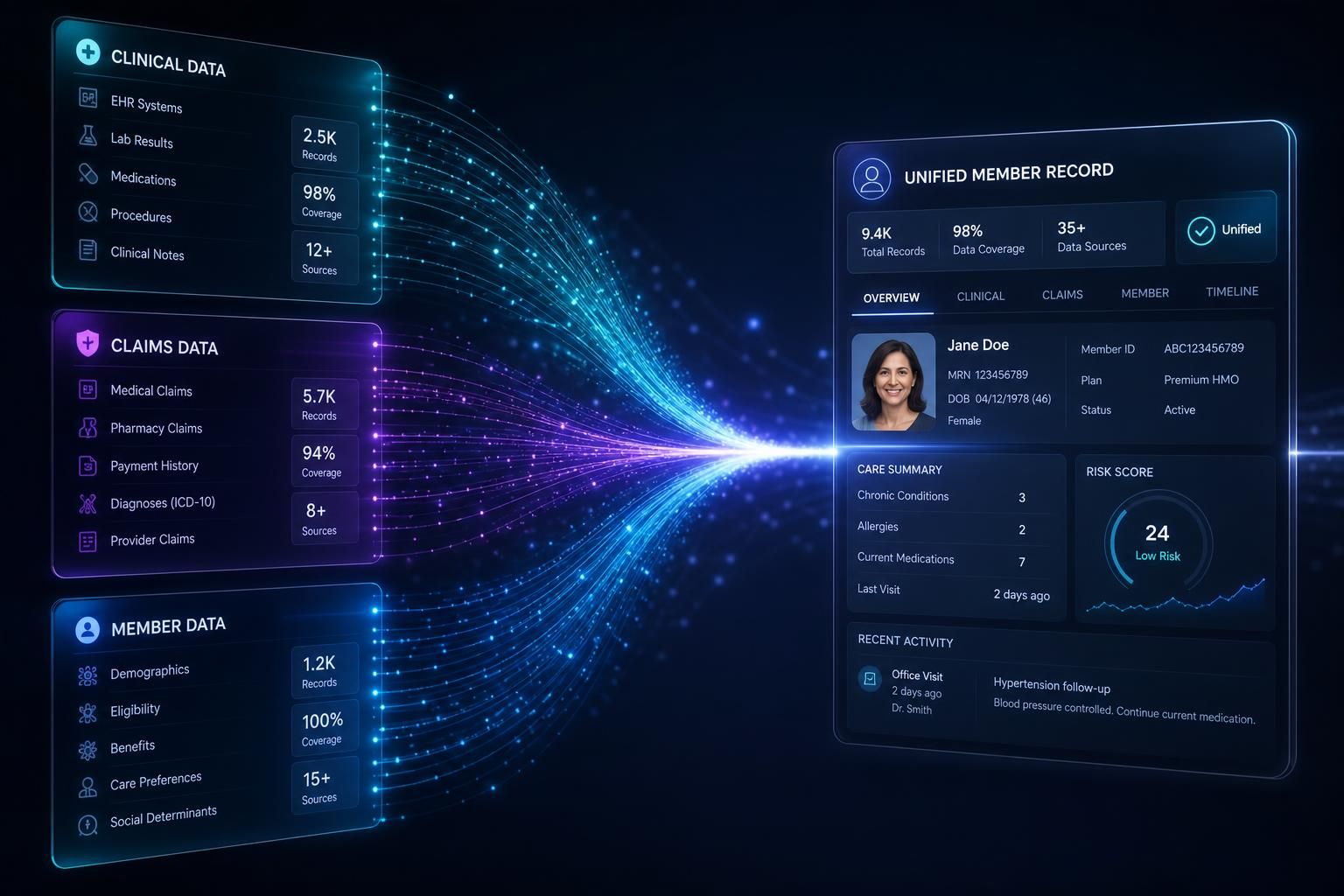
Healthcare has never lacked data. It has lacked togetherness.
Across the continuum of care, we generate a relentless river of records — claims, clinical notes, lab results, imaging, device feeds, prior authorizations, care plans, social determinants, and patient-reported outcomes. Yet too often those signals arrive as scattered shards: technically "available," operationally "unusable," and analytically "unsafe." The Great Healthcare Unification is the industry's long-running campaign to turn fragmented facts into coordinated, compliant, and clinically credible intelligence.
This article examines the hard truths (and real upside) of data unification — especially as AI and agentic AI accelerate decision-making. Unification can be transformative. It can also be treacherous when pursued as a tooling exercise rather than a strategy.

Why unification is so difficult: the five fractures
1) Semantic mismatch: when "the same" isn't the same
Interoperability is not merely moving messages — it is preserving meaning. A "problem list" entry in one EHR may be a billing-coded diagnosis in another. A medication "active" status may reflect a prescription, not adherence. A care gap may be a quality measure artifact, not a clinical reality. When organizations unify data without a shared semantic model (terminologies, code systems, measure logic, provenance), they unify noise as efficiently as they unify truth.
2) Workflow mismatch: data that arrives too late (or too early)
The continuum of care is a choreography of timing:
- ▸Emergency care needs near-real-time context (allergies, meds, recent encounters).
- ▸Inpatient care needs longitudinal history plus immediate orders and results.
- ▸Post-acute and home health need care plans, functional status, and transitions-of-care clarity.
- ▸Payers need adjudication-ready, policy-aligned facts.
Unification fails when the architecture ignores latency, event triggers, and operational handoffs. A perfect dataset delivered 48 hours late can be clinically irrelevant.
3) Governance mismatch: "data access" vs. "data accountability"
Healthcare leaders often ask, "Can we get the data?" The more consequential question is, "Can we defend it?" Unification increases blast radius. A single mapping error, identity mismatch, or access-control gap can propagate across analytics, care management, quality reporting, and AI. In a regulated environment, governance is not bureaucracy — it is the scaffolding that allows scale.
4) Identity mismatch: the patient is not a primary key
Master patient index (MPI) and identity resolution remain foundational — and frequently underfunded. Duplicate records, overlay errors, and inconsistent demographic capture can turn unification into a high-speed misattribution engine.
5) Incentive mismatch: interoperability is political
The 21st Century Cures Act and related rules push the industry toward broader electronic health information access and discourage information blocking, but implementation still collides with competing incentives, contractual constraints, and risk tolerance across stakeholders. The result: progress, punctuated by friction.

The case for unification: what becomes possible
A safer, smarter continuum of care
When unification is done well, it improves continuity, reduces duplicative testing, and supports more reliable transitions.
- ▸Preventive care: unified registries and measure logic improve outreach and gap closure.
- ▸Acute care: consolidated histories reduce medication errors and support faster differential diagnosis.
- ▸Chronic disease management: longitudinal views enable risk stratification and personalized interventions.
- ▸Behavioral health integration: coordinated data reduces "shadow charts" and improves follow-through.
- ▸Post-acute and home health: better handoffs reduce readmissions and missed services.
Operational efficiency with auditability
Unified data can reduce manual reconciliation, accelerate prior authorization workflows, and improve revenue integrity — if lineage and controls are built in.
AI that is actually accountable
AI models are only as trustworthy as the data supply chain behind them. Unification with strong provenance, quality controls, and monitoring enables:
- ▸reproducible feature engineering
- ▸bias and drift detection
- ▸explainability aligned to clinical and operational stakeholders
- ▸defensible model governance
Unification can create a "single source of confusion"
A centralized platform without semantic discipline becomes a high-volume contradiction generator. Teams lose trust, revert to spreadsheets, and the organization ends up with more fragmentation — just with better infrastructure.
Overreach: boiling the ocean, burning the budget
Many programs fail because they attempt enterprise-wide unification before proving value in a bounded domain (e.g., readmissions, HEDIS, care management, claims automation). Unification should be phased, outcome-led, and measurable.
Security and privacy risk amplification
Centralizing data increases the impact of misconfiguration. Privacy rules, minimum-necessary principles, and role-based access must be engineered — not assumed. Unification without rigorous access controls and auditing is not modernization; it is risk concentration.
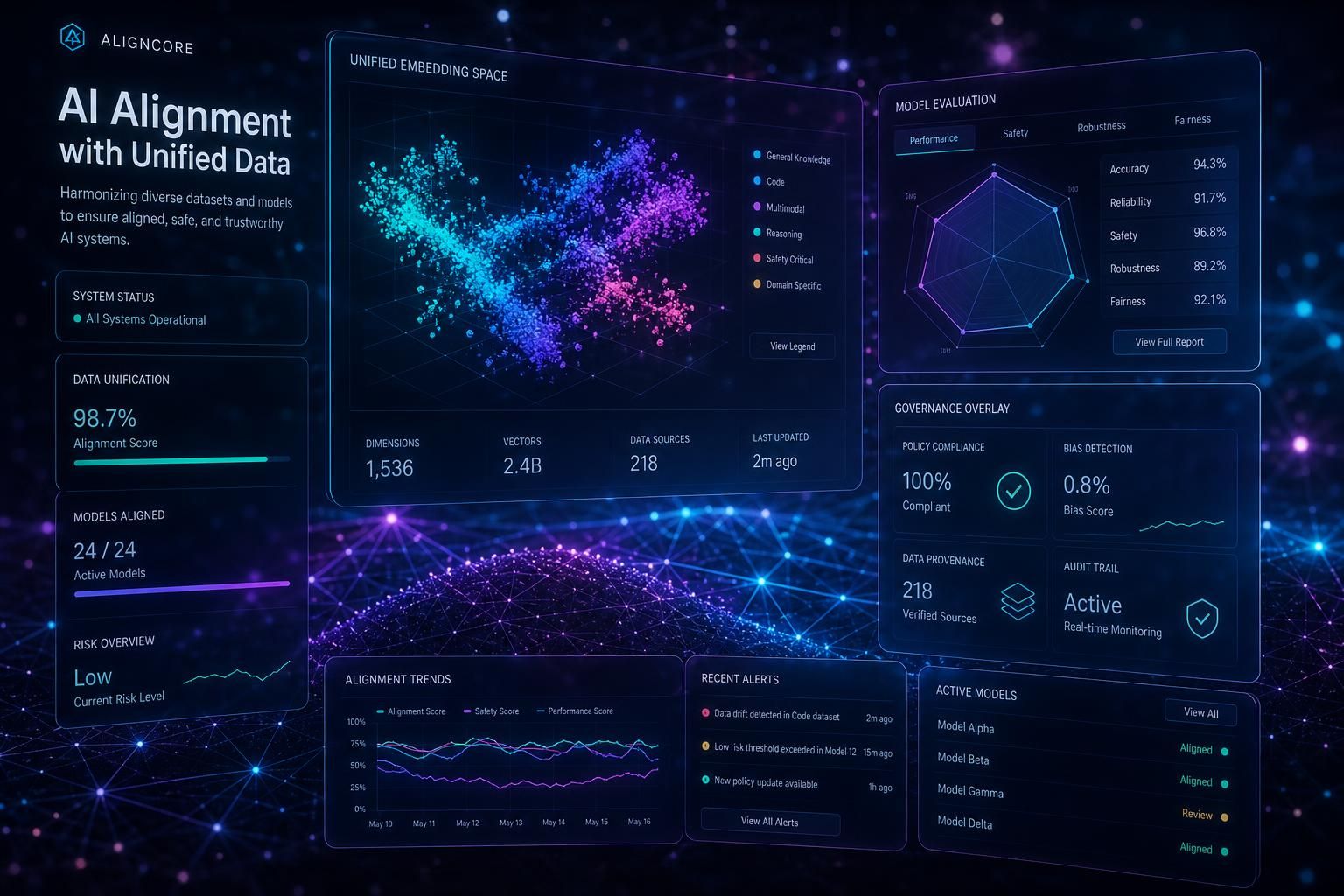
AI and agentic AI: acceleration without alignment
Agentic AI — systems that can plan, decide, and take actions across tools — raises the stakes. In healthcare, "autonomy" touches clinical safety, regulatory compliance, reimbursement integrity, and patient trust.
If your unified data layer contains identity errors, ambiguous semantics, or incomplete provenance, agentic AI can operationalize those flaws at machine speed.
A practical way to frame the risk: AI amplifies what you already are. If your data foundation is disciplined, AI scales insight. If it is disorderly, AI scales dysfunction.
Interoperability's perils: integration is not a victory lap
Standards help — but they do not finish the job
HL7 FHIR has accelerated API-based exchange, and USCDI has clarified a baseline dataset. TEFCA aims to connect networks under common "rules of the road." These are meaningful advances. But standards do not guarantee consistent implementation, terminology usage, measure logic, data quality, or identity resolution. Interoperability is a necessary condition for unification — not a sufficient one.
The "last mile" is where programs succeed or stall
The last mile includes:
- ▸mapping and normalization
- ▸clinical validation of definitions
- ▸exception handling (missing, contradictory, late-arriving data)
- ▸governance workflows (approvals, stewardship, change control)
- ▸operational adoption (training, trust-building, feedback loops)
This is where many initiatives underestimate effort.
What strategic planning looks like (before AI touches production)
A durable unification program typically includes:
- ▸Outcome-first scope: choose 1–3 high-value use cases with measurable KPIs.
- ▸Data product design: define consumers, semantics, SLAs, and lineage.
- ▸Interoperability architecture: decide what is real-time vs. batch; what is canonical vs. source-of-truth.
- ▸Governance-by-design: RBAC, audit logs, retention, de-identification, and stewardship.
- ▸Quality gates: automated checks plus clinical and operational sign-off.
- ▸AI readiness: model risk management, monitoring, and rollback plans aligned to NIST AI RMF concepts.
- ▸Phased delivery: prove value, then expand — without compromising controls.
Where Brandywine Consulting Partners fits — expertise with humility
At Brandywine Consulting Partners, we have learned that healthcare unification is not a "platform project." It is a trust project.
What we do well
BCP specializes in healthcare-exclusive integration, analytics, and Azure-native data platforms — delivered with governance and measurable outcomes. In practice, that means we help clients:
- ▸unify HL7, FHIR, X12, and operational data into governed, auditable pipelines
- ▸build semantic layers that align clinical, financial, and quality definitions
- ▸implement role-based security, tenant isolation patterns, and compliance-ready controls
- ▸deliver executive dashboards and operational reporting that stakeholders can defend
- ▸prepare data foundations for AI/ML and agentic workflows with guardrails
We have seen the impact when unification is executed with discipline: risk stratification and analytics programs that improve outcomes and reduce avoidable utilization — while maintaining high availability and data integrity.
What we have learned the hard way
We also stay candid about the realities:
- ▸Identity is never "done." It is a living capability.
- ▸Definitions drift. Measures change. Workflows evolve. Your semantic layer must be governed like code.
- ▸Interoperability is not neutral. Every interface encodes assumptions; every mapping is a clinical and financial decision.
- ▸AI raises the bar. If you cannot explain your data lineage, you cannot responsibly automate decisions.
Our most successful engagements are the ones where we co-design with clinical, operational, compliance, and IT stakeholders — because unification that ignores people and process becomes an expensive technical artifact.
A practical call to action: unify with intent, not impulse
The Great Healthcare Unification is not about forcing every dataset into one warehouse. It is about creating a reliable, governed, interoperable foundation that supports safer care, smarter operations, and responsible AI.
If your organization is exploring interoperability expansion, TEFCA participation, enterprise analytics modernization, or agentic AI initiatives, start with a hard question:
Do we understand the meaning, movement, and monitoring of our data well enough to let automation act on it?
If the answer is "not yet," that is not failure — it is clarity. And clarity is where good architecture begins. BCP is ready to help — practically, collaboratively, and with the humility that healthcare complexity demands.
References
- ▸Office of the National Coordinator for Health IT (ONC). Cures Act Final Rule. healthit.gov
- ▸Federal Register. 21st Century Cures Act: Interoperability, Information Blocking, and the ONC Health IT Certification Program (Final Rule). federalregister.gov
- ▸Centers for Medicare & Medicaid Services (CMS). Interoperability and Patient Access Fact Sheet. cms.gov
- ▸Office of the National Coordinator for Health IT (ONC). TEFCA Overview. healthit.gov
- ▸National Institute of Standards and Technology (NIST). Artificial Intelligence Risk Management Framework (AI RMF 1.0). nist.gov
Ready to put this into practice?
BCP partners with healthcare and life sciences leaders to translate strategy into shipped, secure systems. Let's talk about your next initiative.
Talk to BCP