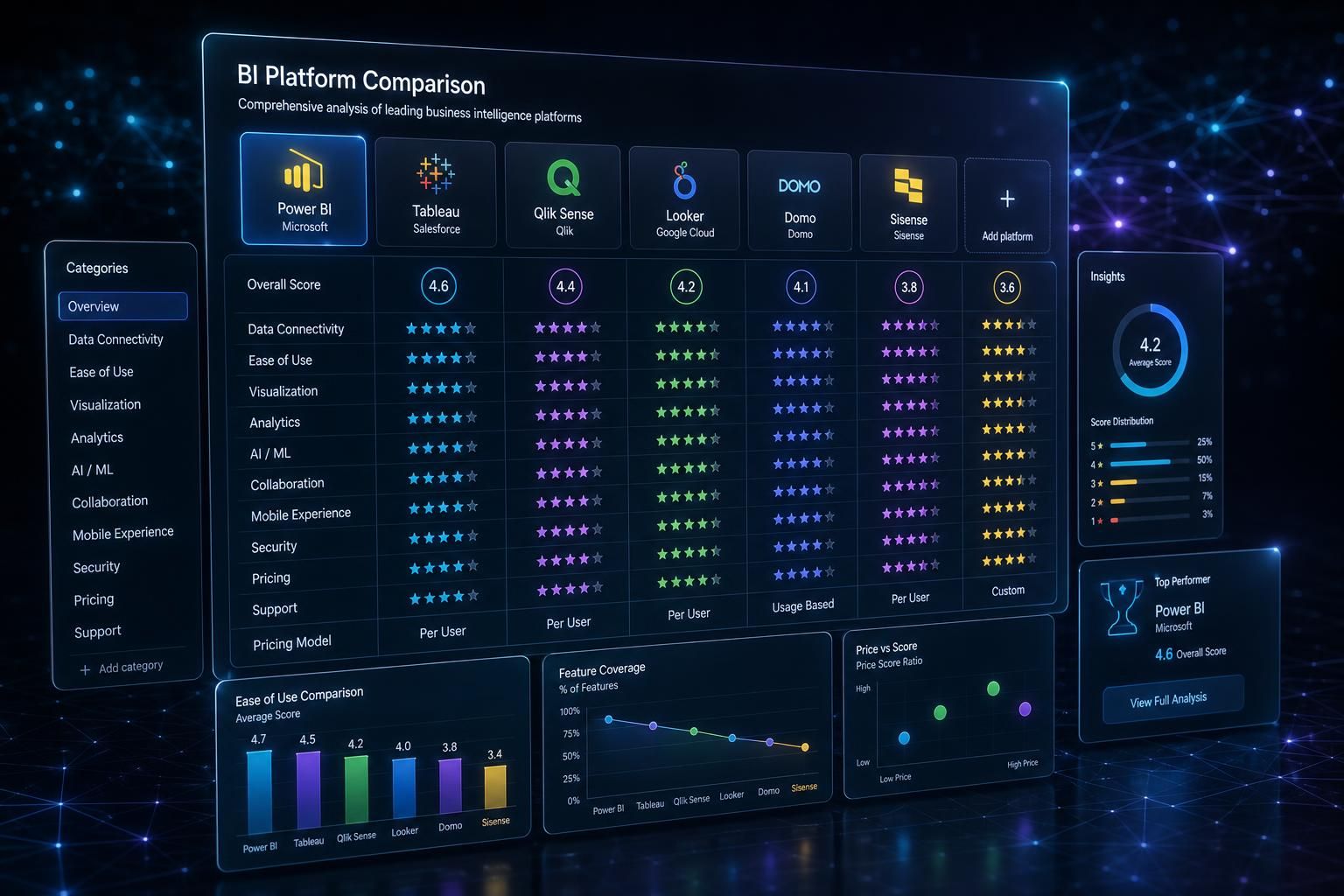
Every healthcare leader we work with eventually asks the same question: which BI platform should we standardize on? It is the wrong question, but it is the right instinct. The right question is: which platform best fits our data architecture, our users, our compliance posture, and the next three years of our roadmap?
This article walks through how Brandywine Consulting Partners evaluates the major BI platforms for healthcare clients — Power BI, Tableau, Sisense, Qlik Sense, Looker, and Databricks SQL / AI/BI — and the trade-offs that drive the decision.
Power BI
Microsoft Power BI is the default choice for healthcare organizations already invested in Azure and Microsoft 365. Strengths include:
- ▸Tight integration with Azure data services and Fabric
- ▸Strong DAX modeling and an industry-leading semantic layer
- ▸Per-user licensing that scales gently for smaller organizations
- ▸Mature row-level and object-level security
Watch-outs: complex deployments require thoughtful capacity sizing, and the licensing model becomes harder to reason about at enterprise scale.
Tableau
Tableau remains the gold standard for visual analysis and storytelling. Strengths:
- ▸Best-in-class visualization library and exploratory experience
- ▸Strong with diverse, multi-cloud data sources
- ▸Tableau Server / Cloud governance is mature
Watch-outs: the semantic layer is improving but historically lagged Power BI; per-user licensing is more expensive; performance tuning often requires extracts rather than live connections.
Sisense
Sisense shines in embedded analytics — organizations building data products for their customers. Strengths:
- ▸ElastiCube in-memory engine handles complex joins gracefully
- ▸White-label and embedded experiences are first-class
- ▸AI-driven insights and natural language are well integrated
Watch-outs: smaller community than Power BI / Tableau, fewer pre-built connectors, and a more developer-centric model that can intimidate citizen analysts.
Qlik Sense
Qlik's associative engine offers a fundamentally different exploration model — every selection updates the whole dashboard, surfacing related and unrelated data in real time. Strengths:
- ▸Powerful free-form discovery for analysts
- ▸Strong scripting language for complex transformations
- ▸Mature governance for regulated industries
Watch-outs: the associative model has a learning curve; modern UI feels less polished than Tableau or Power BI; cost can be high for large user communities.
Looker
Looker (now part of Google Cloud) takes the LookML modeling approach — every metric is defined in code, version-controlled, and reused across reports. Strengths:
- ▸Excellent governance and consistency at scale
- ▸Strong fit for engineering-led analytics teams
- ▸Tight integration with BigQuery and modern data warehouses
Watch-outs: visualization library is intentionally constrained; LookML is powerful but requires engineering investment; pricing is enterprise-oriented.
Databricks SQL & AI/BI
For organizations standardizing on the lakehouse, Databricks now offers integrated SQL warehousing and AI/BI dashboards directly on top of Delta Lake. Strengths:
- ▸Eliminates a data movement step between lakehouse and BI
- ▸Unified governance via Unity Catalog
- ▸Strong for ML-adjacent analytics use cases
Watch-outs: dashboarding is newer and less feature-rich than dedicated BI tools; best for organizations already committed to Databricks.
How BCP Helps Healthcare Organizations Choose
We do not have a preferred vendor. We have a structured selection process that starts with the business and works backward to the platform:
- ▸Catalog the actual analytics workloads — operational, executive, embedded, ad-hoc, regulatory
- ▸Map the existing data architecture and skills inventory
- ▸Quantify total cost over a 3-year horizon, not just license fees
- ▸Run a structured proof of value on the top two candidates with real data
- ▸Recommend, document trade-offs, and build a transition plan
Multi-Platform is Sometimes the Right Answer
Many healthcare organizations end up running two BI platforms, intentionally: one for governed enterprise reporting, one for embedded customer-facing analytics. That is fine — as long as it is a deliberate choice with a clear governance model, not an accidental sprawl.
Final Thought
The BI platform decision is consequential, but it is rarely the most important decision in an analytics program. Data quality, semantic modeling, governance, and adoption matter more. A great platform on top of a weak foundation produces fast, beautiful, untrusted dashboards. We help clients invest in the foundation first — and then choose the platform that best amplifies it.
Ready to put this into practice?
BCP partners with healthcare and life sciences leaders to translate strategy into shipped, secure systems. Let's talk about your next initiative.
Talk to BCP