Large language models like GPT-5, Claude, and Gemini are being woven into healthcare workflows at remarkable speed: patient communication, clinical documentation, prior authorization, risk stratification, even compliance review. The upside is real. So is the risk.
LLMs do not "know" what is true. They produce statistically plausible text. Without intentional safeguards, they can be manipulated by adversarial inputs, hallucinate confidently incorrect clinical information, or be biased by the data they were trained on. In healthcare, those failure modes are not academic — they translate directly into patient safety, regulatory, and reputational risk.
At Brandywine Consulting Partners, we treat LLM safety as a first-class engineering concern. This article walks through the practices we apply when deploying LLM-powered features in clinical and operational settings.
Establish a Clear Use Boundary
The first decision is the most important: what is the model allowed to do, and what is it explicitly not allowed to do? We document this as part of every LLM design. A model that summarizes prior authorization requests is not allowed to recommend clinical treatment. A model that drafts patient outreach messages is not allowed to release without human review. Boundaries should be both technical (system prompts, tool restrictions, output validators) and procedural (governance, training, monitoring).
Defend Against Prompt Injection
Prompt injection is the SQL injection of the LLM era — adversarial text inside a document, email, or web page that tricks the model into ignoring its instructions. In healthcare contexts, attackers might try to:
- ▸Exfiltrate PHI by smuggling instructions into a clinical note
- ▸Manipulate model output to recommend unsafe medications
- ▸Bypass disclaimers required for patient-facing communication
We defend against this in layers: untrusted content is clearly delimited and labeled to the model, system prompts are protected from override, output is validated against a schema, and tool calls require explicit user confirmation when they have real-world side effects.
Ground the Model in Trusted Sources
Hallucination risk drops dramatically when the model is required to ground every claim in retrieved evidence. Retrieval-augmented generation (RAG) over a curated knowledge base — clinical guidelines, payer policies, internal SOPs — gives the model the right context and a clear chain of provenance.
We treat the retrieval pipeline as a critical system in its own right: indexed and versioned, monitored for drift, tested with adversarial queries, and audited for source quality.
Always Cite, Always Show Your Work
Every LLM-generated output that informs a decision should include the underlying evidence. This is true for clinicians reviewing AI-suggested documentation, analysts reviewing AI-summarized reports, and patients reading AI-drafted explanations. Citation and traceability are how we earn trust — and how we make errors detectable when they occur.
Measure What Actually Matters
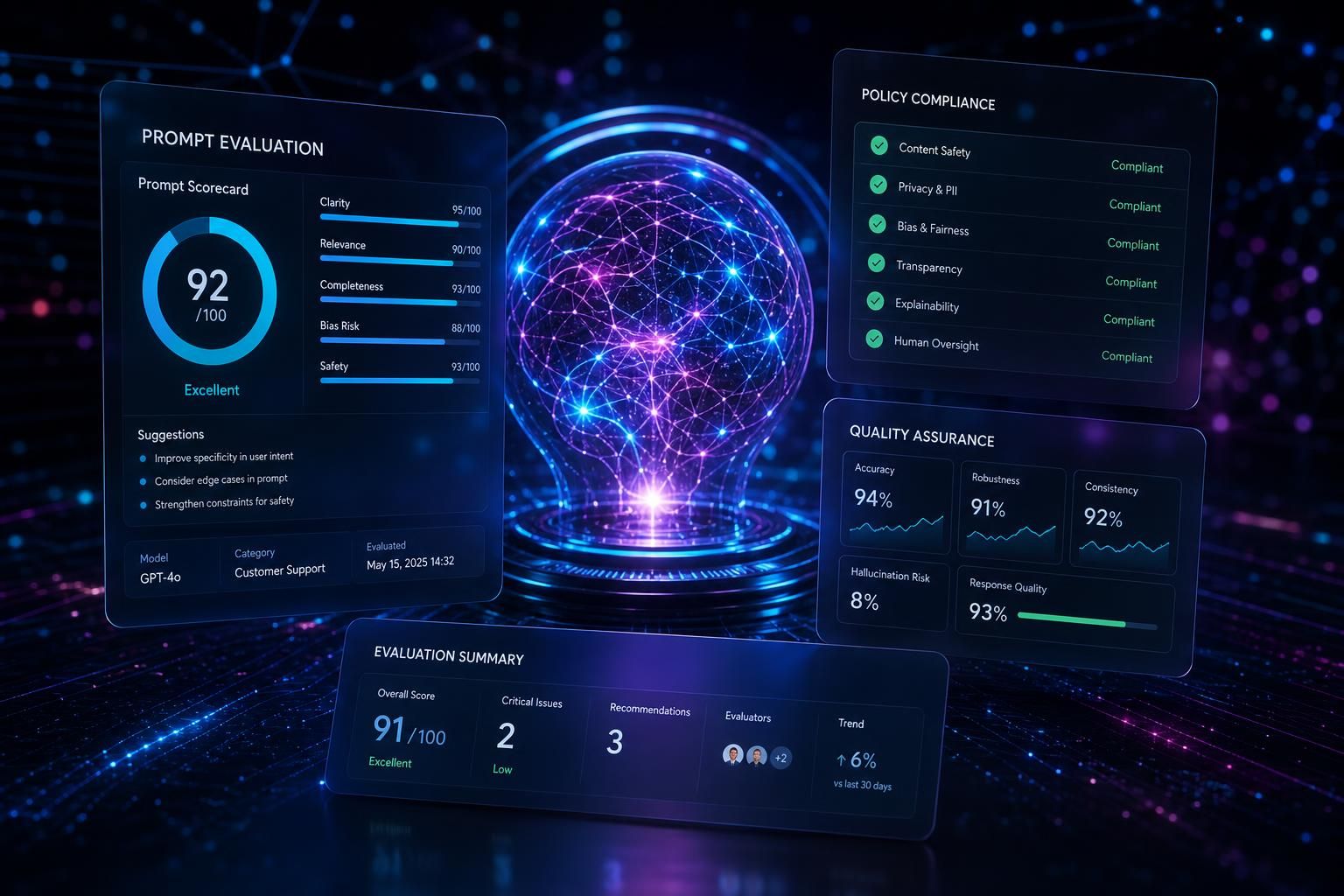
Generic LLM benchmarks are nearly useless for healthcare deployments. The metrics that matter are domain-specific: factuality on a curated test set, refusal rate on out-of-scope queries, calibration of confidence, and the rate at which human reviewers accept or modify generated output.
We build evaluation harnesses that run on every model or prompt change, so regressions are caught before they reach production. We also instrument production for ongoing monitoring — drift in input distribution or output quality is a warning sign that the system is degrading.
Keep Humans Authoritatively in the Loop
For any decision with clinical, financial, or regulatory weight, a human reviews and approves the model output. This is not just risk mitigation — it is good system design. The model handles the heavy lifting of synthesis and drafting; the human applies judgment and accountability. The interface should make it easy for the reviewer to see, edit, and reject — not pressure them into rubber-stamping.
Govern the Lifecycle
LLM systems require ongoing governance: versioned prompts, a model registry, change-management for upgrades, incident response plans, and regular adversarial red-teaming. We work with clients to stand up these capabilities so AI deployments remain safe as the technology and threat landscape evolve.
The Bottom Line
LLMs are powerful. They are also fallible in ways that matter enormously in healthcare. The organizations that capture the upside without taking on unacceptable risk are the ones that engineer for safety from the first design conversation. That is the standard BCP applies on every AI / ML engagement.
Ready to put this into practice?
BCP partners with healthcare and life sciences leaders to translate strategy into shipped, secure systems. Let's talk about your next initiative.
Talk to BCP